
Highlight 15/2026: From Forecasts to Decisions: The ‘Last Mile Problem’ in Energy Systems
Adhitheya Jyothi Saravanan, 18 May 2026
Advances in forecasting have greatly improved the ability to anticipate weather patterns, extreme events and long-term climate variability. Across climate services, from early warning systems to applications in sectors such as agriculture, water management and energy, increasingly sophisticated forecasting models have the ability to provide more precise and timely information. However, these improvements do not always lead to better outcomes. Despite more accurate forecasts, vulnerabilities persist and responses remain uneven, highlighting a growing gap between knowledge and action.
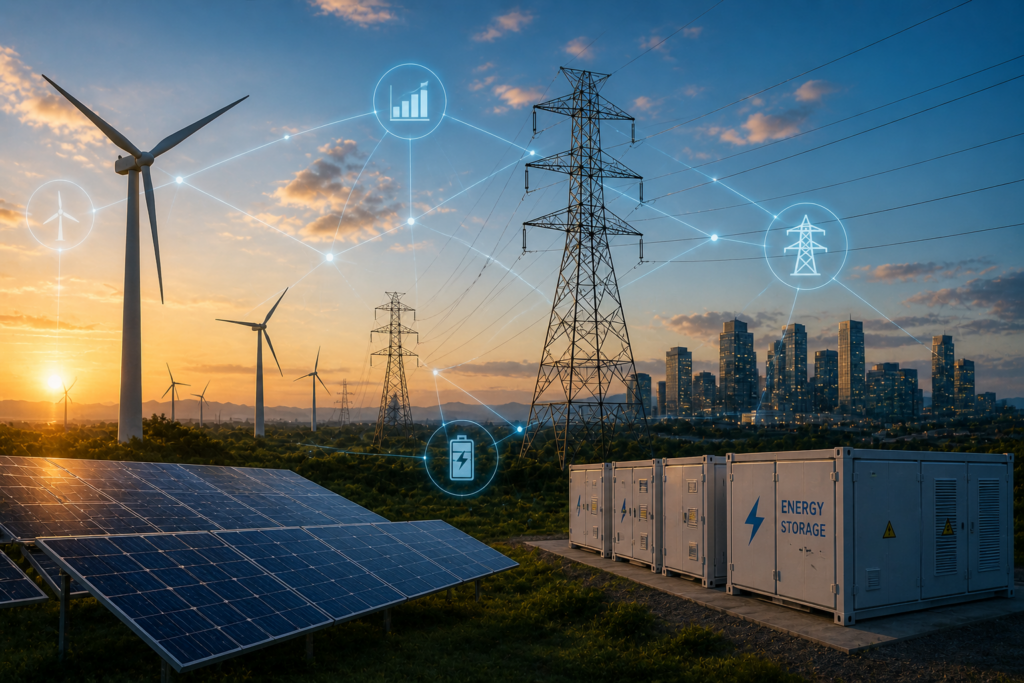
Within this broader context, modern energy systems are undergoing a major shift driven by electrification, decentralisation and the rapid growth of variable renewable energy. At the same time, advances in artificial intelligence (AI) and digitalisation have greatly improved the accuracy, speed and detail of forecasting. Yet despite these gains, a key gap remains: better forecasts do not always lead to better decisions. This disconnect is often described as the “last mile problem” in energy systems. In today’s energy systems, the problem is no longer predicting the future but acting on it.
Recent evidence shows that AI is playing an increasingly central role in the energy transition, supporting applications from demand forecasting to grid optimisation and real-time system balancing. Organisations such as the International Energy Agency (IEA) and the International Renewable Energy Agency (IRENA) highlight how AI-based forecasting helps operators better anticipate renewable generation and manage more complex electricity systems. In principle, these capabilities should improve system reliability and support faster decarbonisation.
However, the main challenge is no longer producing accurate forecasts but using them effectively in real-time operational decision-making. Energy systems involve multiple actors including grid operators, regulators, utilities and market participants, each with their own incentives and constraints. As noted in the AI for Energy report, the electricity grid is one of the most complex systems ever built requiring constant coordination across many interconnected components. In this context, even highly accurate predictions may have limited impact if they are not properly integrated into institutional workflows.
A key limitation relates to how probabilistic forecasts are used. While AI models can estimate uncertainty with increasing accuracy, these results do not automatically translate to clear actions. For example, knowing there is a high chance of low wind generation does not directly tell operators how much reserve capacity to activate or how markets should respond. This gap between information and action is therefore not a technical problem, but a challenge of governance and system design.
Moreover, the rapid expansion of data centres and digital infrastructure adds another layer of complexity. AI acts as both a solution and a source of pressure: while it helps optimise energy systems, it also drives up electricity demand, putting additional strain on grids and infrastructure. This creates a paradox where digital innovation improves forecasting but also increases the need for better decision-making frameworks.
Another constraint lies in the “black box” nature of many AI models which can limit trust and usability. As noted by the IEA, effective use of AI in energy systems requires models to be interpretable, validated and integrated into human-in-the-loop decision processes.
Addressing the last mile problem therefore requires a shift in focus from developing better technology to improving governance, interoperability and system integration. The The International Renewable Energy Agency (IRENA) work on digitalisation in the energy sector highlights the need for coordinated digital strategies, standardised data, and stronger institutional alignment to fully realise the value of AI-driven systems.
Ultimately, the effectiveness of future energy systems will depend not only on how well we can predict outcomes but on how effectively institutions can act on those predictions. Bridging the gap between forecasts and decisions is therefore not just a technical issue, but a governance challenge at the heart of the energy transition. In this sense, the energy transition is no longer a problem of information but of implementation.
Adhitheya Jyothi Saravanan, Highlight 15/2026: From Forecasts to Decisions: The ‘Last Mile Problem’ in Energy Systems, 18 May2026, available at www.meig.ch
The views expressed in the MEIG Highlights are personal to the authors and neither reflect the positions of the MEIG Programme nor those of the University of Geneva