
Highlight 7/2026: The EU’s New Pact on Migration and Asylum
Joël de Bruin, 25 February 2026
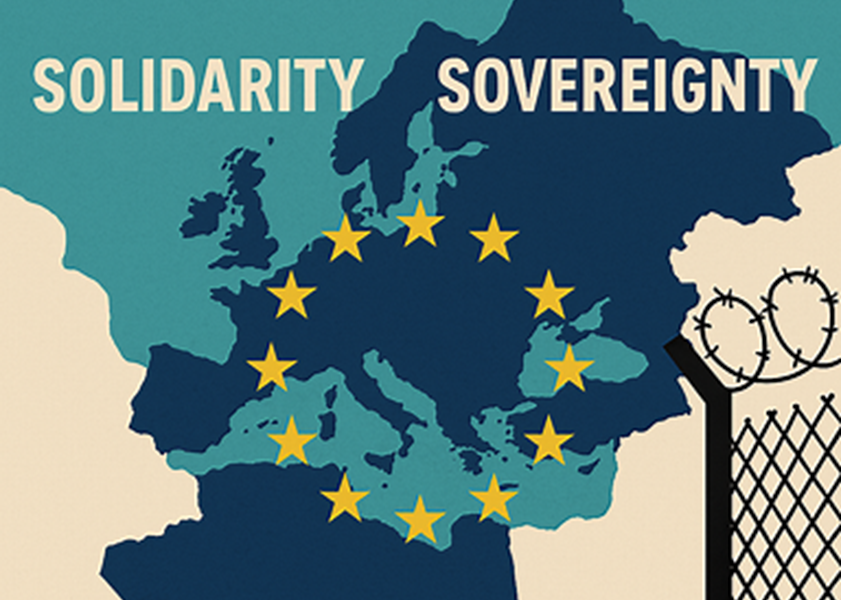
The EU’s New Pact on Migration and Asylum is a major legal achievement, but its technical solutions cannot conceal the political truth: that member states are presented with tough decisions between solidarity and sovereignty, and that the future of the Pact will be determined not in Brussels but in the capitals and at the external borders.
The Pact offers harmonized screening procedures, quicker border procedures, and a mandatory but flexible solidarity mechanism that is supposed to alleviate pressure on frontline countries and inject much-needed predictability into the Common European Asylum System. However, the political compromise that led to the Pact has left uncertain whether the solidarity mechanism will be operational or merely decorative: relocation, financial compensation, and in-kind support are on the table, but their political acceptability differs widely from one capital to another, and the country of first entry logic remains a deep-seated fault line.
Implementation is a race against time and resources. The Pact demands new screening facilities, biometric systems, trained personnel, and harmonized national action plans in 27 legal systems within short deadlines; where administrations are resource-constrained or lack political will, disparities will generate legal challenges and domestic grievance that populists can capitalize on. The monitoring and conditionality role of the European Commission will be significant, but the politics of enforcement will further polarize the EU.
A disturbing trend is the downward pressure on standards, as when countries seek to demonstrate that they are “tough” on migration, this can lead to a race to the bottom in terms of reception conditions, procedural guarantees, and access to counsel. Civil society organizations have warned that the acceleration of border procedures, the extension of detention, and the legal fiction of “non-entry” threaten to reverse progress on non-refoulement and other fundamental guarantees.
Externalization and bilateral agreements are politically attractive because they seem to cut the number of arrivals quickly, but they fragment the EU’s policy and can also externalize responsibility to partners who have weak protection policies. These agreements can make headlines in the short term while undermining the normative position of the EU. The success of the Pact, therefore, lies in linking external cooperation with strong safeguards.
Academic commentary points to structural constraints: “The Pact deals with irregular arrivals, but there are gaps in relation to legal migration and integration channels, which are crucial in order to alleviate pressure and offer realistic alternatives to irregular migration.” Without genuine legal options and investment in integration, tougher border policies will merely shift migration flows and, in the worst-case scenario, fuel more risky smuggling rings.
Academic review also cautions against the risk of unintended consequences, where fast-track procedures and derogations in times of crisis may give rise to risks of litigation and potentially embed a culture of exceptionalism, while electronic surveillance and biometric systems may give rise to privacy and discrimination concerns that will be challenged in court and civil society. The Pact’s longevity will depend on whether its protections are sufficiently strong to resist legal and political challenge.
If the Pact is to transcend the Brussels compromise, political leaders must be willing to bear short-term costs for long-term cohesion: solidarity that is transparent and verifiable, legal channels that are more than mere promises, strong safeguards for human rights, and investment in capacity. Without all of these, the Pact may become a precarious ceasefire that papered over differences but did little to alter the reality of European migration policy.
Joël de Bruin, Highlight 7/2026: The EU’s New Pact on Migration and Asylum, 25 February 2026, available at www.meig.ch
The views expressed in the MEIG Highlights are personal to the authors and neither reflect the positions of the MEIG Programme nor those of the University of Geneva.