
Highlight 3/2026: What is rare? Rare Earth or Strategic Governance? A Case Study in Long-Term Value-Chain Coordination
Shengyu Qin, 28 January 2026
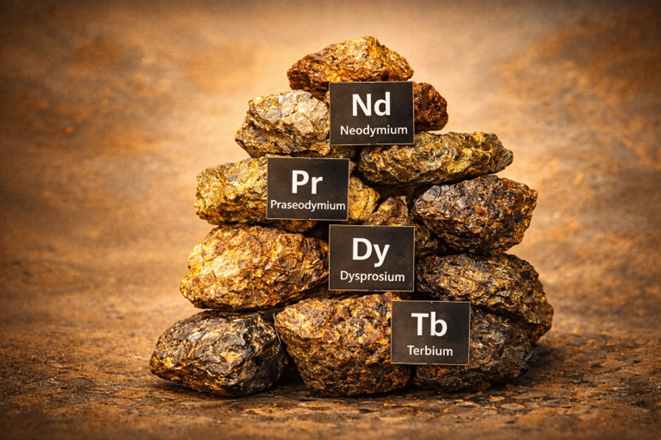
Rare earths and critical minerals have become a focal point of global debate in recent times. As countries race to secure inputs for the energy transition, digitalisation, and defence technologies, export controls, stockpiling initiatives, and “friend-shoring” strategies announced in 2025–2026 reflect a growing sense of urgency. What is often framed as a resource problem is, in reality, a question of leverage, and of who controls the most critical segments of the value chain.
A useful correction to this debate is that rare earth elements are not rare in geological terms. Analysts such as Michael Wade have pointed out that deposits are relatively widespread, and that only a subset of the 17 rare earth elements tends to become supply-critical at any given time. Public geological data reinforces this view. Scarcity, therefore, is not primarily about volume underground, but about the ability to extract, separate, process, and integrate these materials into advanced manufacturing.
Seen through this lens, China’s position in the rare earth ecosystem appears less exceptional and more instructive. China’s leverage did not emerge overnight, nor was it the result of a single policy choice. Early reform-era industrial thinking, often associated with the Deng Xiaoping period, recognised the strategic relevance of upstream inputs. What followed was not merely recognition, but persistence: decades of investment in processing capacity, tolerance for environmental and financial costs that others avoided, and coordination across state, industry, and trade policy. The export controls debated today only function as leverage because the earlier governance created deep path dependency.
This case suggests that strategic advantage is rarely generated by foresight alone. Many countries understood the importance of rare earths early on. Fewer were willing or able to sustain the institutional coordination required to act on that understanding over time. Strategic governance, instead of geology, has explained the divergence.
This perspective increasingly resonates with current international agendas. Both the World Economic Forum and the United Nations now frame critical minerals as a coordination challenge spanning finance, standards, sustainability, and supply-chain resilience. Implicitly, they acknowledge that minerals become “critical” when governance fails to keep pace with technological change.
The rare earth case also highlights a more uncomfortable reality: what counts as a strategic resource is shaped by technology and society, not by nature alone. This means that the most durable advantage lies not in predicting which mineral will matter next, but in building governance systems capable of adapting before constraints become crises.
As the global energy transition accelerates, I dare to ask: Can international cooperation move from reactive competition toward anticipatory coordination, or will strategic minerals continue to be governed only once leverage has already shifted?
Shengyu Qin, Highlight 3/2026: What is rare? Rare Earth or Strategic Governance? A Case Study in Long-Term Value-Chain Coordination, 28 January 2026, available at www.meig.ch
The views expressed in the MEIG Highlights are personal to the authors and neither reflect the positions of the MEIG Programme nor those of the University of Geneva.