
Highlight 1/2026: European strategic autonomy and dependence on NATO: Taking the middle-road
Joël de Bruin, 12 January 2026
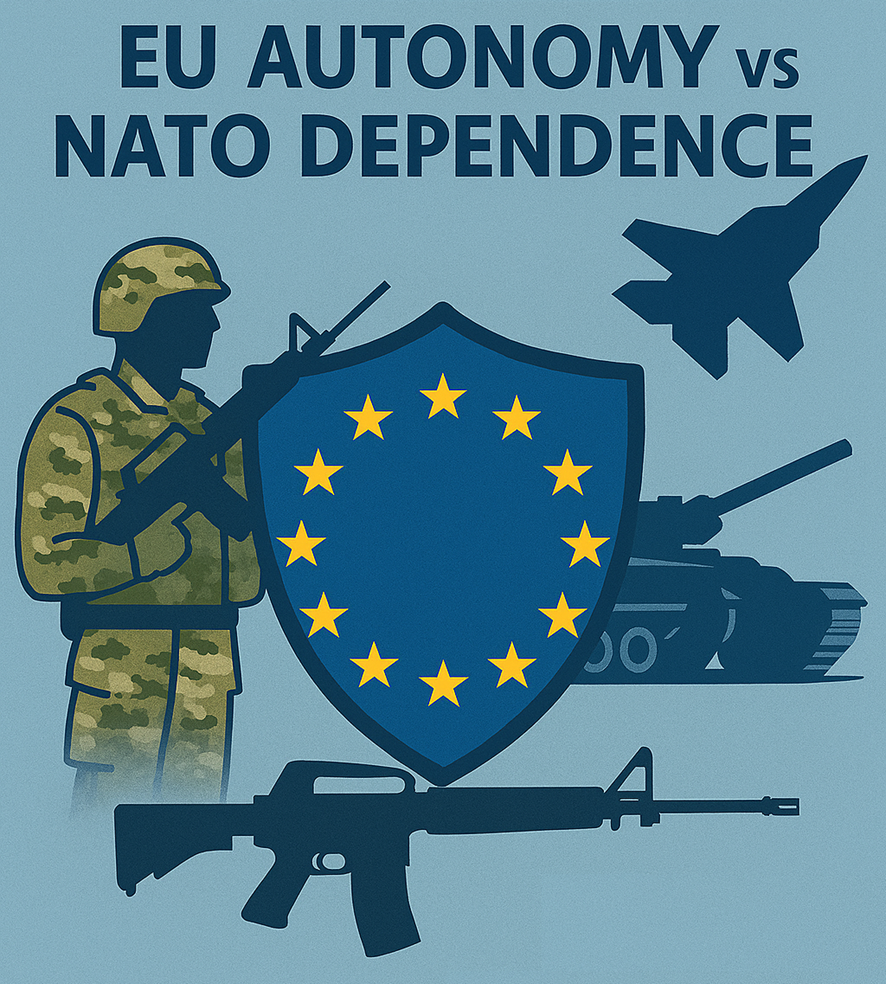
Europe’s pursuit of strategic autonomy is first and foremost a matter of political independence and credibility. If European states can make and implement strategic choices without being constantly subject to external political fluctuations, their policies will carry more weight in sensitive regions such as the southern flank and Eastern Europe. Strengthening European decision‑making capacity would allow the EU to present coherent crisis responses and sanctions policies that are seen as credible and consistent, rather than contingent on shifts in another capital’s politics. Credible, autonomous policy-making increases Europe’s influence in crisis management and sanctions dossiers and reduces the perception that European strategy is merely reactive.
A strong example of this is the Re-Arm Europe plan 2030, which has Security Action for Europe (SAFE) as its first pillar. SAFE consists of 150 billion Euros in long-term loans to member states requesting financial assistance for investments in defense capabilities. It is believed that this will unlock 800 billion euros of defense spending across all of the EU.
Recent volatility in trans‑Atlantic politics has shown that reliance on a single ally’s political will creates strategic vulnerability; Europe must therefore build capabilities and industrial capacity so it is not wholly dependent on one partner or one defence supply chain. Investing in European defence industries and dual‑use technologies reduces exposure to sudden policy reversals and supply disruptions. Spreading risk through capability development and industrial autonomy is a hedge against geopolitical uncertainty.
Crucially, pursuing autonomy does not mean leaving NATO. On the contrary, a more capable and self‑reliant Europe can be a stronger, more equal partner within the Alliance, improving burden‑sharing and making cooperation more sustainable and effective rather than duplicative or competitive. When the EU can act independently where appropriate, it can coordinate with NATO from a position of parity, shaping joint strategies rather than merely following them.
Economic and technological sovereignty are integral to strategic autonomy. Defence capability is tied to economic sovereignty: control over critical technologies, satellites, artificial intelligence, cyber tools and secure supply chains which protects European interests in a competitive global market and underpins operational independence. Building these capacities domestically strengthens both deterrence and the ability to act without external bottlenecks. Investing in critical technologies is an investment in strategic freedom.
However, NATO’s Article 5 collective defence remains a powerful deterrent, even with the EU’s own Treaty on European Union’s article 42 (7), and the Common Security and Defence Policy (with PESCO) in mind: the guarantee that an attack on one is an attack on all provides immediate security reassurance and a strong preventive effect. At the same time, it remains complementary to NATO and does not replace existing alliance commitments. Moreover, NATO’s intelligence‑sharing, surveillance networks and early‑warning systems materially improve situational awareness and speed up decision‑making in crises. These capabilities are costly and complex to replicate quickly, and they argue for continued NATO membership even as Europe builds autonomy.
The sensible path is dual-track: accelerate European defense capability, industrial and technological autonomy so the EU can act credibly and independently where needed, while remaining fully engaged in NATO to preserve collective deterrence and intelligence benefits. This approach makes Europe a more equal, more resilient partner which is less likely to be drawn into conflicts by external political shifts, and better able to contribute meaningfully to shared security.
Joël de Bruin, Highlight 1/2026: European strategic autonomy and dependence on NATO: Taking the middle-road, 12 January 2026, available at www.meig.ch
The views expressed in the MEIG Highlights are personal to the authors and neither reflect the positions of the MEIG Programme nor those of the University of Geneva.